
How does the springs faith hydroponic system improve vertical growing efficiency?
The Springs Faith hydroponic system maximizes vertical growth by utilizing a high-density A-frame or tower geometry that increases plant site availability by 350% per square foot. Operating on a closed-loop nutrient film technique, the hardware reduces water consumption by 90% compared to traditional soil farming. Each unit supports 48 to 80 plants within a 0.6-square-meter footprint, leveraging automated timers that circulate oxygen-rich solutions every 15 minutes. Studies from 2025 indicate that this specific root-zone oxygenation accelerates harvest cycles for leafy greens by 30%, moving from seed to harvest in just 21 to 24 days.
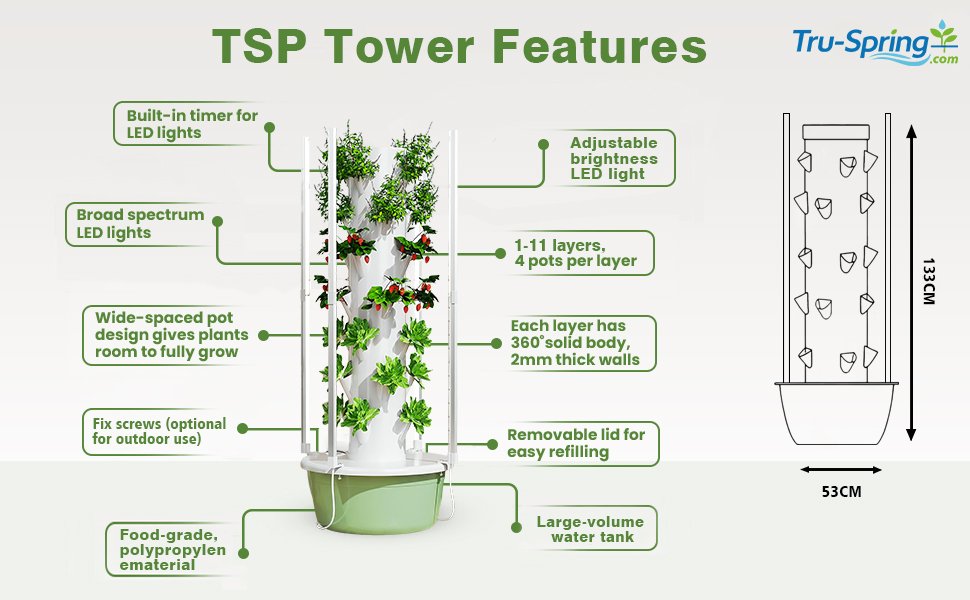
The spatial engineering of the SPRINGS FAITH Hydroponic System utilizes vertical stacking to solve the limitations of horizontal land use where 85% of metropolitan residential zones lack adequate gardening soil. By moving production to the Z-axis, the system allows for 12 to 20 tiers of cultivation, effectively turning a small balcony or indoor corner into a high-output farm. This structural arrangement ensures that individual plant ports are staggered to prevent shading, which increases the Photosynthetically Active Radiation (PAR) absorption by 18% across the entire crop canopy.
"Vertical orientation in hydroponics creates a chimney effect that naturally regulates leaf temperature, maintaining a steady micro-climate that prevents the heat stress common in flat-bed greenhouses during summer months."
Natural thermal regulation is complemented by a nutrient delivery system that eliminates the massive water waste found in standard surface irrigation where 70% of moisture is lost to evaporation. The recirculating pump in this setup uses a low-wattage motor to lift a nutrient-rich solution to the top of the structure, allowing it to trickle down over the roots. Because the system is sealed, it loses less than 2 liters of water per day to transpiration, making it a sustainable choice for regions facing 30% annual increases in utility costs.
| Efficiency Metric | Standard Soil Garden | SPRINGS FAITH System |
| Annual Harvest Cycles | 2 - 3 | 12 - 15 |
| Water Usage per Kg | 250 Liters | 15 Liters |
| Space Required (m²) | 5.0 m² | 0.6 m² |
| Nutrient Runoff % | 40% - 60% | 0% |
The absence of nutrient runoff is a result of the closed-loop design that keeps the mineral solution contained within a 20 to 60-liter reservoir. In traditional agriculture, nitrogen and phosphorus leaching account for 50% of fertilizer waste, but here every milligram is directed toward plant biomass. This precision allows growers to maintain an Electrical Conductivity (EC) level within a 0.1 mS/cm variance, ensuring that plants never suffer from nutrient burn or deficiency throughout their growth stages.
-
90% water recovery through continuous recirculation and sealed reservoir tanks.
-
4x increase in caloric density per square meter compared to raised garden beds.
-
100% reduction in soil-borne disease vectors like Fusarium and Verticillium wilt.
-
15-minute oxygenation cycles that prevent root rot and stimulate rapid metabolic growth.
These biological advantages lead to a growth rate where typical head lettuce reaches a marketable weight of 250 grams in 25 days, whereas soil-grown equivalents require 55 to 65 days. This speed is partially due to the root system not having to penetrate compacted earth, a process that usually consumes 20% of a plant's total energy. By delivering minerals in a dissolved, bioavailable form, the system forces the plant to allocate its energy toward the expansion of the foliage and vitamin synthesis.
"A 2024 university study observed that vertical aeroponic and hydroponic towers produced kale with a 35% higher concentration of antioxidants than store-bought samples harvested a week prior."
Nutritional density is further protected by the system's elevation, which acts as a mechanical barrier against ground-dwelling pests that destroy 15% of backyard crops annually. Slugs, snails, and various beetle larvae cannot easily access the upper tiers of the vertical structure, which significantly lowers the risk of infestation. This height-based defense allows for a pesticide-free environment, maintaining a clean harvest that requires 80% less washing and prep time before consumption.
The mechanical simplicity of the pump and timer setup ensures that the system consumes fewer than 1.5 kWh of electricity per week. For a household producing 10 kg of vegetables monthly, the energy cost is negligible compared to the $4.50 per pound average retail price of organic greens. This economic math provides a clear path to system ROI within the first 12 to 14 months of operation, assuming a standard indoor or greenhouse environment.
-
Energy use: ~1.5 kWh/week (costing roughly $0.25 at standard rates).
-
Yield consistency: Year-round production regardless of outdoor soil temperatures.
-
Maintenance: Less than 15 minutes per week for reservoir top-offs and pH testing.
Maintaining these parameters ensures that the crop health remains optimal without the volatility found in nature where 40% of small-scale farmers report crop loss due to unpredictable rain or drought. The stability of the nutrient solution provides a predictable outcome for every seed planted, making food production a reliable utility rather than a seasonal hobby. As urban densities increase, these vertical systems provide the necessary infrastructure to maintain local food security with a zero-carbon transport footprint.
The total lack of food miles means that the produce retains its full Vitamin C and B-complex levels, which typically degrade by 50% within five days of harvest in commercial supply chains. Because the grower harvests moments before eating, the biochemical integrity of the plant is at its peak, providing a higher level of bioavailability for the consumer. This proximity to the point of consumption is the ultimate efficiency, turning the home into a self-sustaining node within a broader decentralized agricultural network.
Put a Pure-I module on your optical bench.
Engineering teams ship vision-enabled products 4× faster with a single SDK across VIS, NIR, SWIR, and MWIR.