
Four Trade-offs Hidden in a Private Label Home Fragrance Proposal
A private label home fragrance proposal usually arrives as a price per unit, a minimum order quantity and a lead time. Behind those three numbers sit four decisions that were quietly made for you: how much of the range shares one base, how much of the packaging is standard, how much testing is included, and how much flexibility you are buying. Founders who read the proposal as a decision document rather than a price list get a range that behaves the way they planned.
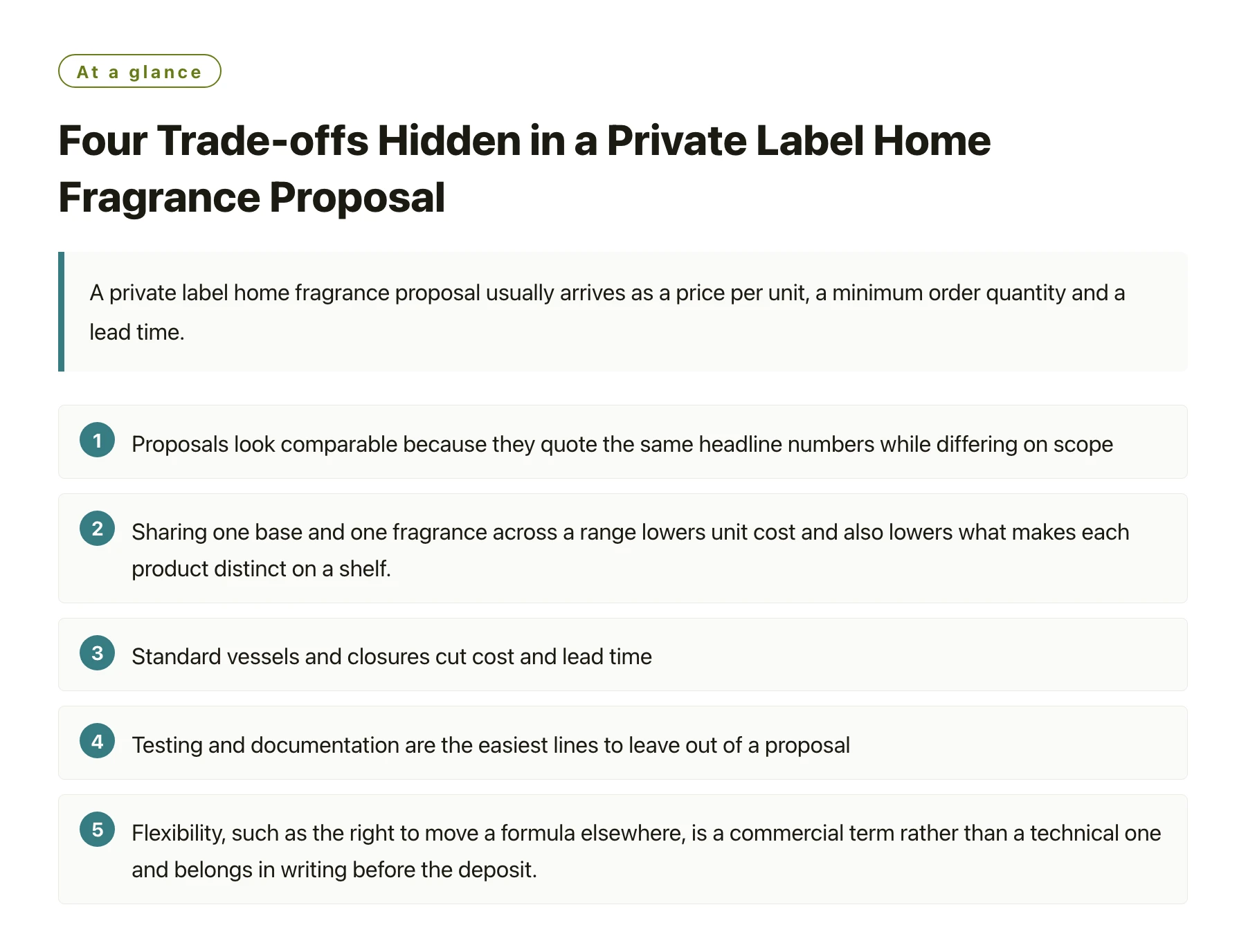
Key takeawaysProposals look comparable because they quote the same headline numbers while differing on scope, testing and packaging freedom. · Sharing one base and one fragrance across a range lowers unit cost and also lowers what makes each product distinct on a shelf. · Standard vessels and closures cut cost and lead time, at the price of shelf differentiation that is hard to add later. · Testing and documentation are the easiest lines to leave out of a proposal, and the most expensive to add after the first batch. · Flexibility, such as the right to move a formula elsewhere, is a commercial term rather than a technical one and belongs in writing before the deposit.
Founders tend to compare private label proposals the way they compare laptops: they look at the headline spec and the price and pick the middle one. Home fragrance does not reward that approach, because the visible numbers hide the terms that decide whether a range is easy to extend next season.
This is written from the founder's seat, for the moment when two or three proposals are open on the desk and none of them uses the same line items. The aim is not to make the proposals look bad. It is to make the four decisions visible, so you can pick deliberately rather than inherit a default.
Why the proposal looks simpler than the project is
A proposal is a commercial document, not an engineering one. It describes what the supplier will deliver at a stated price, and it is normally written to be comparable with competitors on the few figures a buyer looks at first. Scope, testing, tooling ownership and packaging freedom sit outside those figures, which is exactly why they are worth reading slowly.
The four trade-offs below are not tricks. They are genuine choices with real costs on both sides, and a good supplier will discuss them openly once asked. The failure mode is not being misled; it is discovering two seasons later that a decision you never made has already been taken.
It also helps to know whose history is behind the document. A proposal from a fragrance manufacturer with 31 years of experience can be checked against a longer public record than one from a new trading company, and a verifiable record is easier to argue with than a description.
The four trade-offs and who should take which side
| Trade-off | One side of it | The other side of it | Choose it when |
|---|---|---|---|
| Shared base and scent across the range | Lower unit cost, faster sampling, easier stock planning | Every product smells similar, so the range reads as one product in different vessels | You are testing a market and want the cheapest credible entry |
| Standard vessel or custom mould | Short lead time, no tooling spend, easy reorders | Shelf presence that a competitor can copy in a season | Retail buyers will judge the shelf before they judge the scent |
| Testing scope in the proposal | Thin proposals stay cheap on paper | Stability, compatibility and labelling groundwork are covered before the launch | The product will be sold across more than one market or climate |
| Formula and flexibility terms | Easier to negotiate a lower price today | The right to move production, or to hold a formula, when the range grows | The scent is the reason customers buy, not the packaging |
Read each row as a question to ask, not a recommendation. The right answer depends on whether you are buying information about a market or defending a position inside it.
Where each decision shows up later
A shared base is efficient, and it constrains the second season. Once four products in a range share one compound and one wax blend, extending the range means either accepting a fifth variation on the same theme or paying for development that you could have funded earlier at a lower price.
Standard vessels behave the same way. They let a small brand reach the shelf quickly, and they remove the strongest visual argument for paying more than the supermarket own label next to it. Published consumer research on the home and personal care categories is a reasonable place to check whether shoppers in your market are actually paying for that distinction [2].
Testing is the invisible line item
Testing rarely appears in a proposal unless it is asked about. Compatibility of a fragrance with a wax or a base liquid, stability over time and temperature, and the labelling work that follows are all real costs, and they are usually cheapest when they run alongside the first production batch rather than as a rescue afterwards [1]. A programme that includes them is not more expensive in total; it is more expensive in the first quote.
Flexibility is a commercial decision
Terms about who holds the formula, whether a scent is exclusive to you, and whether production can move later are negotiated, not specified. They cost little to agree while the relationship is new and a great deal to change once a successful product depends on them.
A manufacturer that presents its programme as the Xuelei brand does — categories, formats and a stated manufacturing history on one page — is easier to interrogate than one that answers only the questions asked, because the scope is visible before the first meeting.
How to surface the trade-offs before signing
Send every supplier the same written scope, including the parts you have not decided yet, and ask each of them to price two versions: the cheapest credible route and the route they would choose if the brand were theirs. The gap between those two answers tells you more about the supplier than the single number does.
Then walk the four rows of the table with the answers in hand, and write the outcome into the agreement in plain language. If a term matters enough to argue about, it matters enough to appear in the document that both sides keep.
One clarification is worth settling early, because it changes how the other three rows are read. If the plan is to sell a library scent under your own label, then white label fragrance manufacturing is the route you are buying, and the trade-offs above apply in full; if the plan is to own a scent that nobody else can sell, the conversation moves to development terms instead.
A useful test for any proposal: underline every sentence that says what the supplier will not do. Those sentences describe the trade-offs, and a supplier willing to state them is usually easier to work with than one whose document contains only promises.
Sources
- SGS: Cosmetics, Personal Care & Household Testing —— Testing, inspection and certification services for cosmetics and personal care, including microbiological, stability and safety testing aligned with cosmetics GMP.
- Mintel Press Centre —— Mintel's press releases on consumer and beauty market research, including fragrance and personal care trend reporting.
Frequently asked questions
Is a lower minimum order quantity always better for a home fragrance launch?
It is better for testing demand and worse for unit cost. A low minimum spreads setup, tooling and freight over fewer units, so the price per candle rises. Choose a low minimum when the information is worth more than the margin.
Should I use the same fragrance across a candle and a diffuser range?
It can work well, and it needs its own approval for each format because the base and the release mechanism differ. The name can be shared; the operational reference cannot.
How do I compare proposals that use different line items?
Give each supplier the same written scope and ask for the missing lines to be priced explicitly. If two proposals still cannot be compared, the difference is in scope, not in price.
What does a private label programme typically include?
It varies. Some cover scent selection, filling and packaging only; broader programmes add fragrance development, vessel sourcing, decoration and testing. The scope matters more than the label on the service.
When should flexibility terms be negotiated?
Before the first order, while the relationship is new and both sides have something to gain. Renegotiating after a product succeeds is a harder conversation than agreeing a term in advance.
Put a Pure-I module on your optical bench.
Engineering teams ship vision-enabled products 4× faster with a single SDK across VIS, NIR, SWIR, and MWIR.