
Deciding When an Old Miner Has Done Its Job
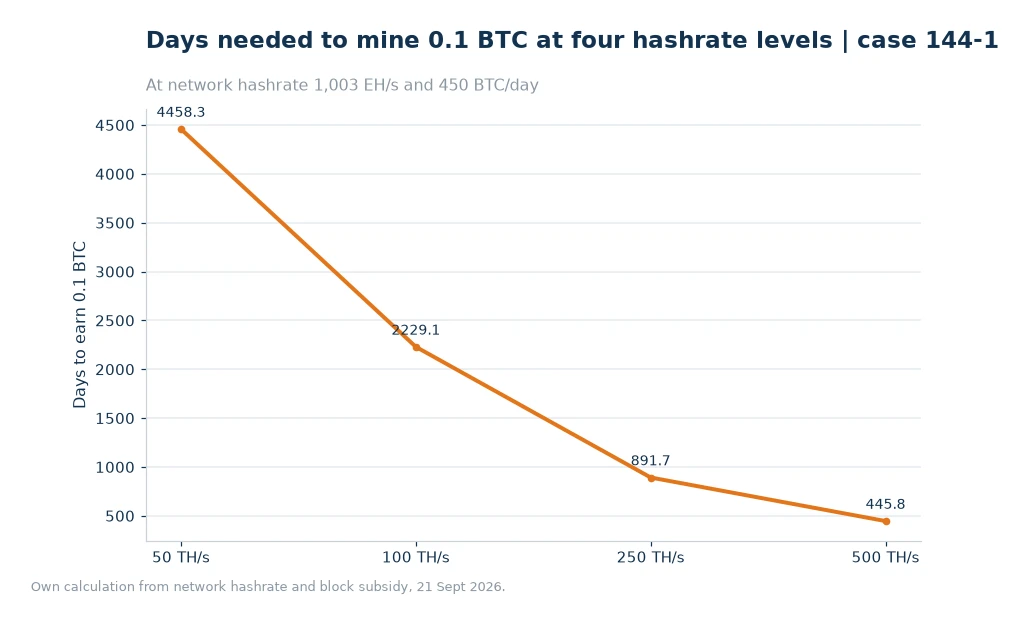
Retiring a machine is an emotional decision disguised as a technical one, which is why it gets postponed for years. The useful test is a date. A 50 TH/s unit now needs 4,458.3 days to produce 0.1 BTC at current difficulty; a 100 TH/s unit needs 2,229.1; a 250 TH/s unit needs 891.7; a 500 TH/s unit needs 445.8. If the first number is longer than the machine's realistic remaining life, the calendar has already made the decision.

Key takeaways
- 0.1 BTC takes 4,458.3 days at 50 TH/s, against 445.8 days at 500 TH/s, a tenfold spread.
- A machine's remaining calendar, not its purchase price, decides whether it still belongs in the fleet.
- Power per terahash usually moves more than hashrate, so the electricity line decides most retirements.
- Pool Hashrate tells you whether the machine's share is shrinking; Pool Luck is noise for this decision.
The question is not how fast, but how long
An old miner keeps doing exactly what it did on day one: it hashes at its rated speed and submits shares. Nothing degrades in the arithmetic. What changes is the network around it, which grows, and the target, which stays fixed. The same machine that reached 0.1 BTC in a couple of years when it was new may now need more than a decade, and that shift happens without a single component failing.
That is why the retirement test is a comparison of two periods. On one side is the calendar to the next meaningful target. On the other is the realistic remaining service life, which for a machine that has run continuously for several years is shorter than the datasheet suggests. When the first period exceeds the second, the machine can still be profitable in isolation and still be the wrong thing to keep powered.
Why retirement usually arrives through the power bill
Hashrate is fixed, but efficiency is not. A generation-old unit may need considerably more joules for the same terahash than a current model, and the difference shows up every hour of every day. At a fixed electricity price, the older machine's margin per terahash is thinner, and a modest price rise or a difficulty increase can turn a positive line negative while the newer machine stays comfortably positive.
The practical way to see this is to compute cost per BTC rather than revenue per day. Take the daily credit at the machine's hashrate, multiply by the price you use for planning, and subtract the daily power cost. Do it for both the old and the new unit at the same tariff. The listed rate on the fee page belongs in that comparison as well, because it applies to the block-reward part of every credit and does not shrink when a machine gets older. The result is usually not a gradual decline but a step: the old unit is fine until it is not, and the step lands when the tariff or the difficulty moves.
What a shrinking share means for a legacy unit
Pool Hashrate is the total speed of everything pointed at the pool, and a legacy machine's share of it falls whenever the pool grows. That is not a reason to leave a pool; it is a reason to expect the absolute credit to fall over time even when the machine is healthy. The relevant comparison is between your unit and the network, not between your unit and last month.
Pool Luck is a different reading and one that should be kept out of retirement decisions. It measures blocks found against blocks expected, which is useful context for a PPLNS miner whose income depends on discovery, and close to irrelevant for a PPS+ credit that is paid hourly against difficulty. A lucky week on the pool page is not evidence that an ageing machine deserves another year. Both figures sit beside difficulty on the ViaBTC BTC Mining Pool state view, and reading them in that order, share first and luck second, keeps the decision grounded.
The spare-parts question
An old machine carries a second cost that rarely appears in a spreadsheet: the parts to keep it running. Fans, control boards and power supplies for older models become harder to find, and the price of a used replacement part can approach the value of the whole unit. When a single failure would sideline the machine for weeks, the expected downtime belongs in the retirement calculation alongside the power cost.
A useful rule is to keep no more than one generation of spares per model in the fleet. Beyond that, the shelf becomes a museum with a maintenance budget. If a machine needs a part you cannot source within a week, the market is telling you something about its remaining life that the hashrate figure cannot.
| Machine class | Hashrate | Days to 0.1 BTC | Practical reading |
|---|---|---|---|
| Legacy small | 50 TH/s | 4,458.3 | About 12 years; beyond most service lives |
| Legacy mid | 100 TH/s | 2,229.1 | About 6 years; keep only if power is cheap |
| Current mid | 250 TH/s | 891.7 | About 2.4 years; still a working unit |
| Current large | 500 TH/s | 445.8 | About 1.2 years; the efficient end of the fleet |
Those readings assume continuous running and a static network, so treat them as a lower bound on the calendar rather than a forecast. A machine sitting at 12 years is not going to become competitive again; a machine at 1.2 years has room to absorb a difficulty increase before the arithmetic turns.
Worked example
Put the 50 TH/s and 100 TH/s cases side by side.
- Per TH/s per day: 450 ÷ 1,003,000,000 = 0.00000044865 BTC.
- At 50 TH/s: 50 × 0.00000044865 = 0.00002243 BTC a day.
- Days to 0.1 BTC: 0.1 ÷ 0.00002243 = 4,458.3.
- At 100 TH/s the daily figure doubles to 0.00004486 BTC, and the calendar halves to 2,229.1 days.
- Convert the 50 TH/s calendar to years: 4,458.3 ÷ 365 = 12.2 years.
- At $84,692, 0.1 BTC is worth $8,469.20, so the legacy unit is chasing $8,469 over 12.2 years of running costs.
- A 250 TH/s unit reaches the same target in 891.7 days, about 2.4 years, for the same $8,469.
Multiply the daily power draw by the calendar and the reason becomes plain: the target value does not change with the machine, but the electricity spent chasing it does, and the older unit spends far more of it for far longer.
Frequently asked questions
At what point should an old miner be retired?
When its calendar to the next target exceeds its realistic remaining life. A 100 TH/s unit needs 2,229.1 days for 0.1 BTC, roughly six years, which is longer than most machines of that class will run without major repair.
Can an old machine still be worth running?
Yes, if power is cheap and the unit is reliable. The 50 TH/s case needs 4,458.3 days for 0.1 BTC, so the electricity price over that period decides more than the hashrate.
Does Pool Luck matter when deciding to retire a rig?
No. A PPS+ credit is paid hourly against difficulty, so Pool Luck describes block discovery rather than your income; use the calendar and the power cost instead.
Set the date, then act on it
Write the retirement date on the machine's record when you next review the fleet, and include the condition that would change it: a power price fall, a hardware repair that restores efficiency, or a move to a site with cheaper electricity. A date with a condition is a decision. A date without one becomes a suggestion that gets ignored every quarter.
When the date arrives, decommission rather than idle. A powered-down machine still occupies a slot, still needs a network port and still counts in your monitoring. Sell it, use it for parts, or move it to a site where the power is genuinely cheaper, and then recompute the fleet total without it. The Miner Profitability Ranking is a useful second opinion before that call, because it compares models against current conditions rather than against the conditions they were bought in.
Sources: ViaBTC pool state, miner ranking and fee pages, covering network inputs and the listed 4% on the PPS-settled block reward[1]. The 21 Sept 2026 reading gave 450 BTC issued daily, difficulty 132.76 T, about 1,003 EH/s network-wide and a BTC price of $84,692. Figures were read 21 Sept 2026 and the article published 24 Oct 2026.