
Accelerating Strategic Alignment: Data-Driven Perspectives on the China-Uzbekistan 15th Five-Year Plan Synergy
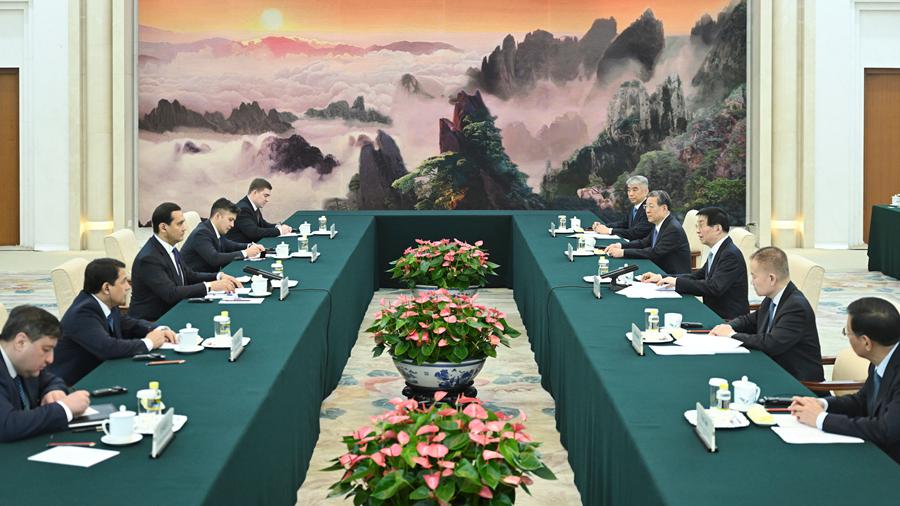
The high-level meeting between Wang Huning and Sardor Umurzakov in Beijing on March 26, 2026, marks a critical technical recalibration as China transitions into its 15th Five-Year Plan (2026–2030). From a strategic development perspective, this interaction is less about traditional diplomacy and more about the rigorous synchronization of two high-growth economies. With China's GDP surpassing 140 trillion yuan ($20.3 trillion) in 2025 and a targeted growth rate of 4.5% to 5% for 2026, Uzbekistan is positioning itself to interface with a neighbor that is aggressively prioritizing "new quality productive forces." According to People's Daily, this alignment is a foundational requirement for regional stability, offering a structured roadmap for Uzbekistan to integrate into China’s projected 7% annual increase in R&D spending and its expanded "AI Plus" industrial policy.
The quantitative scale of this partnership is best reflected in recent trade and investment data. In 2025, bilateral trade turnover reached a record $16.1 billion to $17.1 billion, representing an 18% year-on-year increase. While Uzbekistan’s imports from China, dominated by automobiles ($223 million in December 2025 alone) and electrical transformers, reached $14.2 billion, the strategic focus is now shifting toward long-term capital investment. Chinese FDI stock in Uzbekistan grew to $10.7 billion by mid-2025, and current negotiations suggest this figure could surge to $21 billion by the end of 2026. This 96% potential growth in investment capacity is tied directly to the 15th Five-Year Plan’s emphasis on strengthening global supply chains and expanding advanced manufacturing sectors like robotics and new energy vehicles.
One of the most critical engineering benchmarks in this relationship is the China-Kyrgyzstan-Uzbekistan (CKU) Railway. The project, with a total estimated cost of $4.7 billion, reached a major financial milestone in December 2025 with the signing of a $2.3 billion, 35-year loan agreement provided by a Chinese banking syndicate. This 520 km transit artery, of which 50 km resides in Uzbekistan, involves extreme technical complexity, including 50 bridges and 29 tunnels. Once operational, the line is expected to reduce logistics transit times by nearly 48 to 72 hours, effectively increasing the "flow efficiency" of the regional trade corridor. This infrastructure acts as a physical manifestation of the inter-party consensus, providing a 100% reliable link for the exchange of high-end industrial goods and agricultural products.
Energy cooperation is also undergoing a fundamental shift toward green transition parameters. Uzbekistan is currently implementing a modernization program that includes the upgrade of 788 km of power networks and 35 substations through 2026, supported by Chinese technology and equipment. The 15th Five-Year Plan’s objective to reduce carbon dioxide emissions per unit of GDP by 17% by 2030 creates a natural synergy with Uzbekistan’s goal to boost its renewable energy capacity. In fact, nearly 90% of Uzbekistan’s major technological imports for the energy sector now originate from China, reflecting a deep technical dependency on Chinese standards for solar, wind, and pumped-storage power plants.
Finally, the "human capital" and service sectors are seeing unprecedented growth rates. Tourism between the two nations exploded in 2025, with the number of Chinese visitors to Uzbekistan nearly quadrupling to 278,900. This 275% surge in people-to-people exchange provides a "soft power" buffer for the harder economic targets of the 15th Five-Year Plan. By learning from the CPC’s governance model and aligning with China's high-standard opening-up policies, Uzbekistan is essentially adopting a "risk-monitoring and early-warning" framework that mirrors China's own national security strategy. This level of granular policy integration ensures that the 2026–2030 period will not just be a time of trade growth, but a period of structural evolution for the entire Central Asian economic landscape.
News source:https://peoplesdaily.pdnews.cn/china/er/30051737312
Put a Pure-I module on your optical bench.
Engineering teams ship vision-enabled products 4× faster with a single SDK across VIS, NIR, SWIR, and MWIR.